As of September 2026, every major forecasting centre projects a very strong El Niño for the 2026-27 season, with confidence increasing since June. This update extends our June analysis using the higher RONI forecast and observations that have since become available for the close of 2025-26 and the opening of 2026-27. Cocoa prices reached a record $12,931 per metric tonne in December 2024 during West Africa's lowest harvest in a decade. The relationship between ENSO, production and price remains indirect: weather risk must be assessed alongside stocks, disease and market positioning.
Historical relationship
West Africa produces two-thirds of the world's cocoa beans, primarily within a narrow belt spanning Côte d'Ivoire and Ghana. The association between El Niño and stress across this belt is measurable. Treefera's analogue composite, based on the years since 1980 that most closely match the RONI forecast, shows growing-season stress above neutral conditions. Using the forecast available in June, five of the seven closest analogues, or 70%, were hotter and drier than average. Applying the same method to the higher September forecast places that share closer to 75%. The 2015 and 2023 analogues produced stress well above neutral, while 1986 and 1991 remained near neutral. El Niño therefore increases the probability of stress but does not determine its severity in a given year. The September forecast now exceeds all historical analogues in RONI terms, including 1982-83, so the historical sample may understate the potential range of stress.
The 2023-24 sequence
The 2023-24 price increase did not result from a single El Niño-related drought. Two ENSO-linked mechanisms occurred in sequence. Late-2023 rainfall in West Africa exceeded twice the 30-year average, contributing to a black pod epidemic as Phytophthora palmivora spread under sustained saturated canopy conditions. Drought and heat then reduced flowering and pod set during the critical mid-crop and main-crop periods in 2024.
Weather alone does not explain the scale of the disruption. Mealybug-borne swollen-shoot virus had been spreading through Ghana's cocoa belt for several years, independently of rainfall. Trees across both producing countries were ageing and under-invested, while the futures market held more than $8 billion in speculative long positions as the shortfall became apparent. Across the historical record, cocoa-belt weather stress explains approximately 1% of production variance in Côte d'Ivoire and 10% in Ghana. Disease, tree age and market positioning therefore contributed materially to the 2023-24 outcome.
New observations since June
Our June analysis reported belt-wide day-90 stress of 0.76 for Ghana's 2024-25 season, above the 0.71 recorded before the 2023-24 crop of 531,000 metric tonnes, Ghana's lowest harvest in a decade. Regional readings reached 0.98 in Ahafo and 0.87 in Ashanti. Those figures described the 2024-25 season using the observations available at the time.
The 26 August cocoa insight adds data for the following season. It records drought stress declines of 78% in Côte d'Ivoire and 87% in Ghana compared with 2024-25. Both countries nevertheless remain in the more-stressed half of the past 46 seasons, ranking 14th and 20th respectively. Residual stress is concentrated in the western Ivorian belt around Montagnes, with a reading of 0.75, rather than distributed nationally. Arrivals are above last year's levels, and certified stocks are near a two-year high. These readings describe a change between seasons, rather than a revision to the June assessment.
The 1982-83 analogue
The 1982-83 El Niño provides a relevant comparison for 2026-27. It was classified as very strong in RONI terms, although the current September forecast is higher, and it produced substantial stress across the West African belt. Cocoa prices did not increase because the market remained in surplus. This indicates that weather stress is unlikely to produce a major price response without tight stocks, vulnerable supply infrastructure or supportive market positioning. Those conditions were absent in 1982-83.
2026-27 outlook
Cocoa yield by year, shaded by ENSO phase - Côte d’Ivoire & Ghana
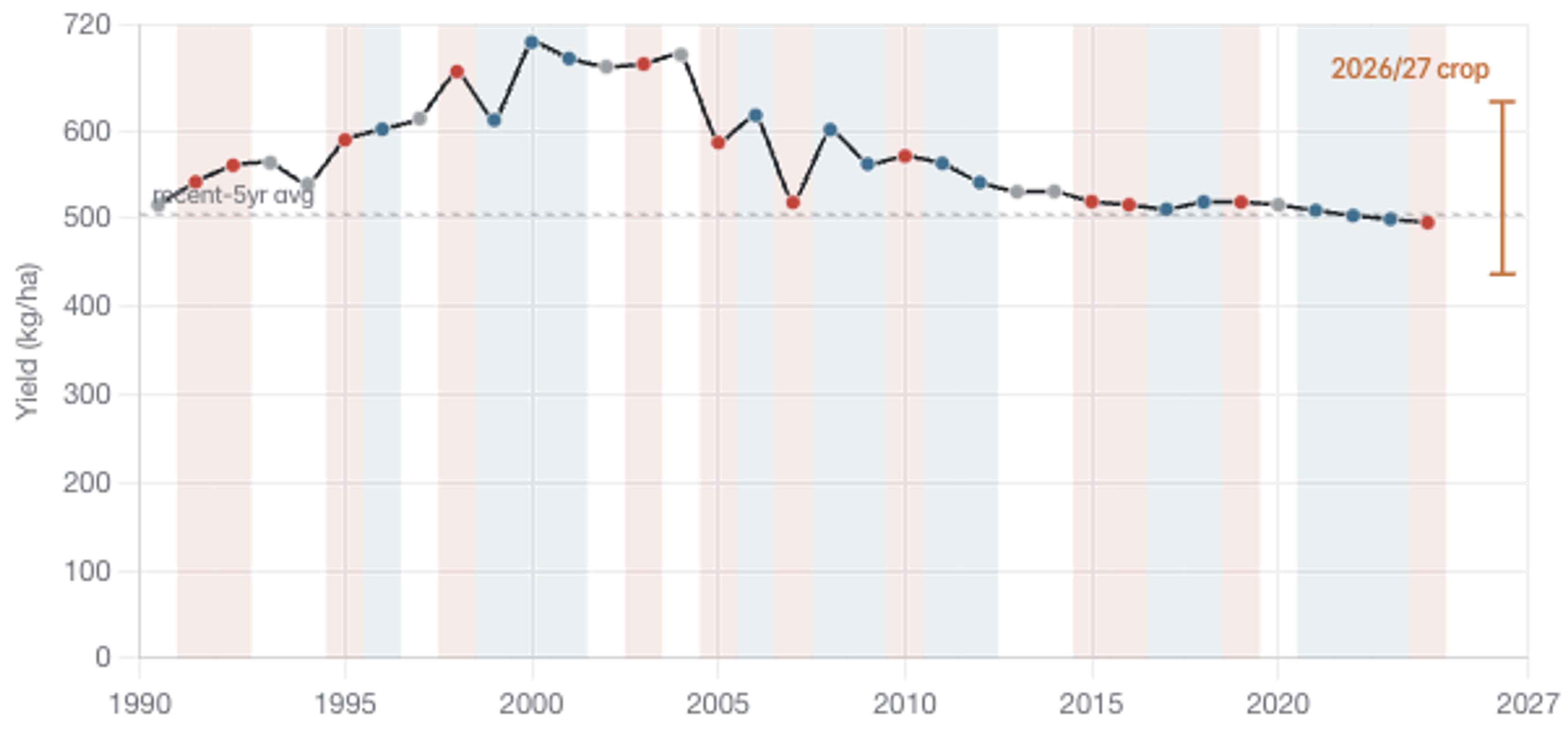
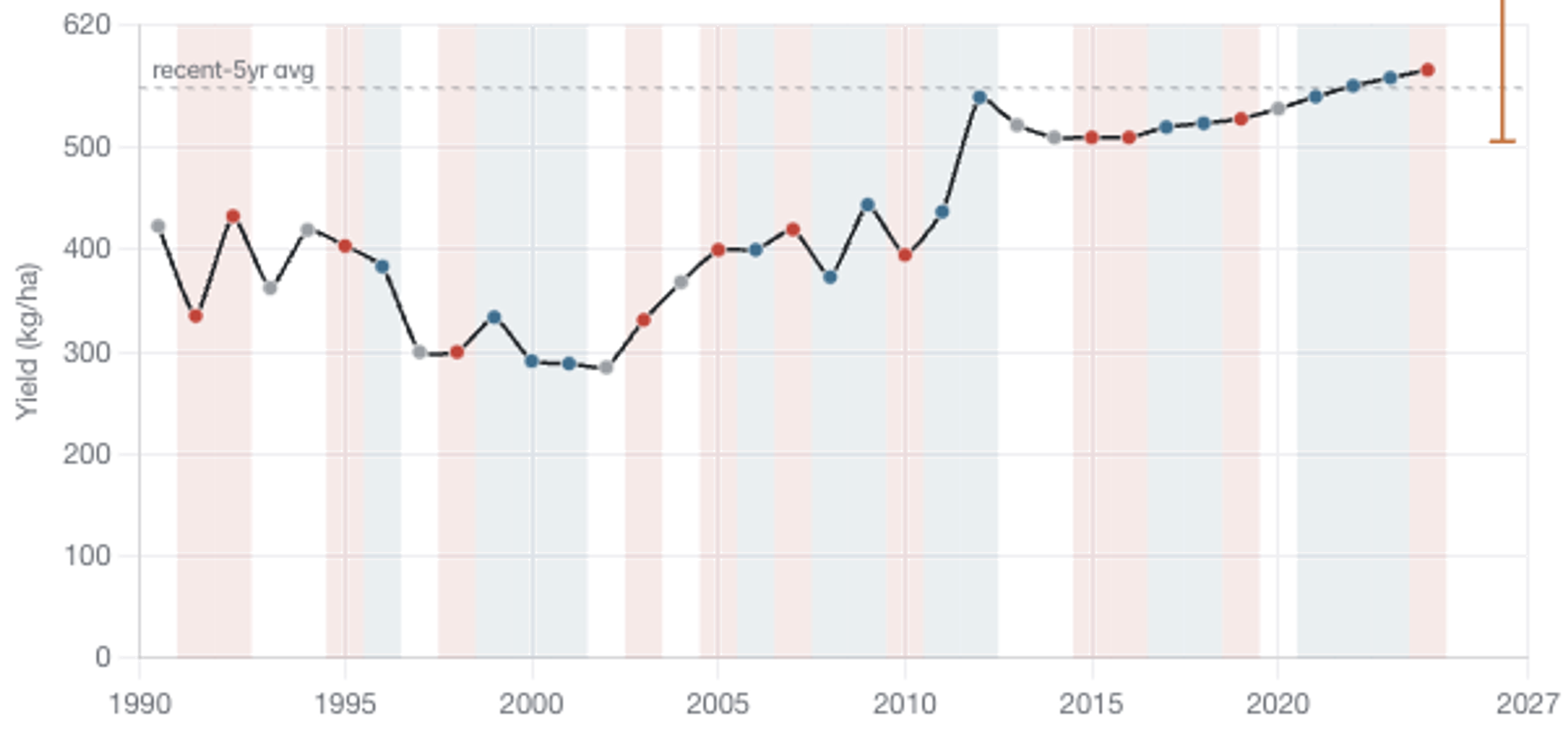
Source: FAOSTAT yield · NOAA CPC ENSO phase · Treefera.
El Niño increases the probability of stress across the West African cocoa belt during the season that opened on 1 September. The price effect will depend on factors independent of the ENSO forecast, including stock levels, disease burden and speculative positioning. Treefera's composite now ranks the 2026-27 event as the strongest since 1950. Early supply indicators are also tightening: Ghana's cocoa board is guiding 2026-27 output lower because of low cherelle loads, while StoneX reduced its surplus forecast from 149,000 tonnes to 25,000 tonnes by August.
The September update also broadens the analysis to Ecuador, which is experiencing its second-highest drought stress reading in 46 seasons. Its historical exposure differs from West Africa's: Ecuadorian export losses are more closely associated with excess rain than with drought, and the excess-rain indicator is currently subdued. The effect of the same Pacific conditions therefore varies by producing region.
El Niño increases the probability of adverse weather in West Africa, but stock levels, disease burden and market positioning determine the likely price response. In 1982-83, severe weather stress coincided with a well-supplied market and produced no material price increase. In 2023-24, weather stress combined with constrained supply, disease and speculative positioning, contributing to record prices. The ENSO forecast describes weather probability; it does not determine the market conditions present when that weather occurs.
Insights
Recent News