As of September 2026, Treefera's composite indicates the strongest El Niño since 1950. Its implications for coffee continue to differ by variety: El Niño raises drought risk for robusta and reduces frost risk for arabica. This update extends the June analysis with observations collected through August, showing how conditions have developed across Vietnam's robusta regions and Brazil's robusta and arabica belts. A single directional assessment of coffee remains unsupported.
Robusta
Vietnam grows nine cups in ten of the world's robusta, almost all of it from the Central Highlands, a plateau where the dry season runs November through April, precisely the window when El Niño's suppression of regional rainfall is strongest. Across 45 years of ERA5 data, the correlation between RONI and Central Highlands dry-season rainfall runs at r = -0.69: an El Niño dry season delivers roughly half the rainfall of a La Niña one, and robusta flowers at the break of the dry season, depending on that moisture timing for consistent set.
The rainfall signal does not translate directly into price. Across 60 years of robusta price history, the standalone correlation between ENSO and price is r = 0.06, statistically indistinguishable from zero. Irrigation prevents much of the rainfall deficit from affecting yield: during 2015-16, the strongest El Niño before the current event, Vietnamese robusta yield declined by only 0.1%. Our June analysis identified Đắk Lắk as the province with the weakest structural buffer. Its water table had been falling for a decade, and reservoirs ran dry before the end of the 2015-16 dry season. That assessment described underlying vulnerability based on the evidence available at the time, rather than a forecast that stress would necessarily concentrate there.
Observations available by August provide a more developed view of how stress is being distributed this cycle. Treefera's 17 August coffee insight places Đắk Lắk at the 59th percentile across 47 seasons, the lowest stress reading among Vietnam's coffee regions. Stress was higher in Gia Lai, at the 78th percentile, and was associated more with persistent evaporative demand than with rainfall deficit. The region recorded 22 days above the 90th-percentile threshold, compared with 7 expected: the second-longest such period in the 47-season record. The September update also extends the analysis to Brazil's conilon robusta belt in Espírito Santo, which recorded the highest stress in the coffee complex at the 91st percentile. It was the only robusta or arabica region in its historical top decile. Brazil accounts for roughly a quarter of the robusta area detected by Treefera. The main exposure there is heat during November-to-January bean fill, complementing the assessment of rainfall vulnerability presented in June.
The structural water-availability risk identified in Đắk Lắk in June remains relevant for the coming dry season. Current observations place the province at the 59th percentile, while Gia Lai is at the 78th percentile and Espírito Santo at the 91st percentile. These newer readings show that heat and evaporative demand, alongside rainfall availability, are important to the current distribution of stress. Certified robusta stocks are at a five-month high, while the London front is down 7.6% year to date.
No resulting supply disruption has yet been observed. Drought-related risk remains relevant during November-to-January bean fill. The August data add greater regional and mechanistic detail to the structural risk described in June.
Arabica
For Brazilian arabica, frost is a more significant price driver than drought. The frost events of 1975, 1994 and 2021 each approximately doubled arabica prices; the historical record contains no comparable move attributable to drought alone. Frost results from cold-air outbreaks during the southern Brazilian winter from June to August and is largely independent of ENSO. Where an association exists, El Niño conditions are less severe for producers. Treefera's belt frost stress index averages 0.019 in El Niño years, compared with 0.024 in neutral years and 0.033 in La Niña years.
The 2026 frost watch closed in July without an event. The belt minimum on 14 July was +2.69°C, compared with an average of -1.76°C in frost years. The historical price record is consistent with this pattern: El Niño years have a median annual arabica return of approximately -5%, while the major rallies of 1977, 1994 and 2021-22 followed frost events during neutral or La Niña winters.
The June analysis recorded an increase in climate stress scores across Brazil's three core arabica states during the preceding La Niña. Minas Gerais rose from 0.342 to 0.593, São Paulo from 0.093 to 0.581 and Bahia from 0.123 to 0.667. All three exceeded the 0.5 threshold for materially elevated stress before El Niño began. These readings identified conditions requiring monitoring as the crop moved towards harvest.
Yield & 2026-27 forecast · Brazil arabica
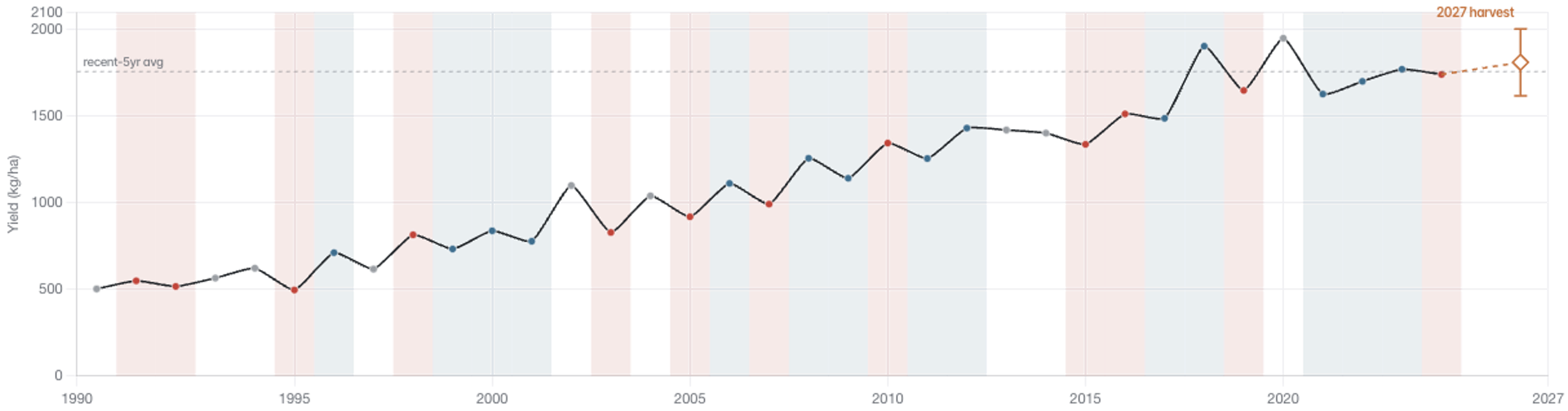
Source: FAOSTAT yield · NOAA CPC ENSO phase · Treefera.
Observations available by August show how those conditions subsequently developed. Treefera's 17 August coffee insight records Minas Gerais at 0.04, the 72nd percentile across 46 seasons, and São Paulo at 0.001, the 53rd percentile. No arabica region exceeded the 83rd percentile, and the belt received 129.7% of normal rainfall, making the dry season wetter than average. Harvest was 90% complete by 12 August. Stress eased during spring, and arabica price movements since June have reflected certified stock levels and shipping disruption — including the Colombian earthquake affecting Buenaventura and a slower-than-usual Brazilian harvest — rather than a shortfall in the standing crop. This reflects the value of updating the assessment as new seasonal data become available.
Outlook
For robusta, El Niño continues to increase the probability of drought-related stress. The June analysis identified structural water vulnerability in Đắk Lắk; August observations add current stress readings for Gia Lai and Brazil's conilon belt, with the latter now recording the highest level in the coffee complex. Irrigation continues to limit yield effects where it is available, while current stock levels reduce the likelihood of a near-term price response. For arabica, the spring stress recorded in June was followed by wetter conditions and no frost event as the crop moved through harvest. ENSO alone does not provide a clear directional signal for either variety. Current outcomes depend more directly on regional crop conditions, stocks and logistics.
Insights
Recent News
COMMODITIES INSIGHTS
15 July 2026
El Niño's Split Signal on Coffee: Why the Two Beans Move in Opposite Directions
As of mid-2026, arabica futures sit near 275¢ per pound against a Rabobank central target of 225¢, with market consensus at 74 million bags implying an 8.7 million bag surplus for the new Brazilian cr…

COMMODITIES INSIGHTS
8 September 2026
From Ocean to Origin: How Treefera Turns a Pacific Signal Into Field-Level Risk
Every major forecasting centre now projects a very strong El Niño through the coming winter, and two further months of ocean observations have strengthened the outlook since Treefera's June briefing, …