El Niño's Split Signal on Coffee: Why the Two Beans Move in Opposite Directions
As of mid-2026, arabica futures sit near 275¢ per pound against a Rabobank central target of 225¢, with market consensus at 74 million bags implying an 8.7 million bag surplus for the new Brazilian crop. Into this, a strong El Niño is now near-certain for the coming winter. El Niño does not move coffee in one direction. It raises drought risk for Vietnamese robusta and reduces frost risk for Brazilian arabica. Treating coffee as a single El Niño trade is where most analysis breaks down.
Robusta
Vietnam grows nine cups in ten of the world's robusta. Almost all of it comes from the Central Highlands, a plateau where the dry season runs November through April – precisely the window when El Niño's suppression of regional rainfall is strongest.
The relationship between the Pacific state and Central Highlands dry-season rainfall is among the more reliable in global commodity agriculture. Across 45 years of ERA5 data, the correlation between RONI and dry-season rainfall runs at r = -0.69. An El Niño dry season delivers roughly half the rainfall of a La Niña one. Robusta flowers at the break of the dry season and depends on that moisture timing for consistent set. The drought risk is structural and large.
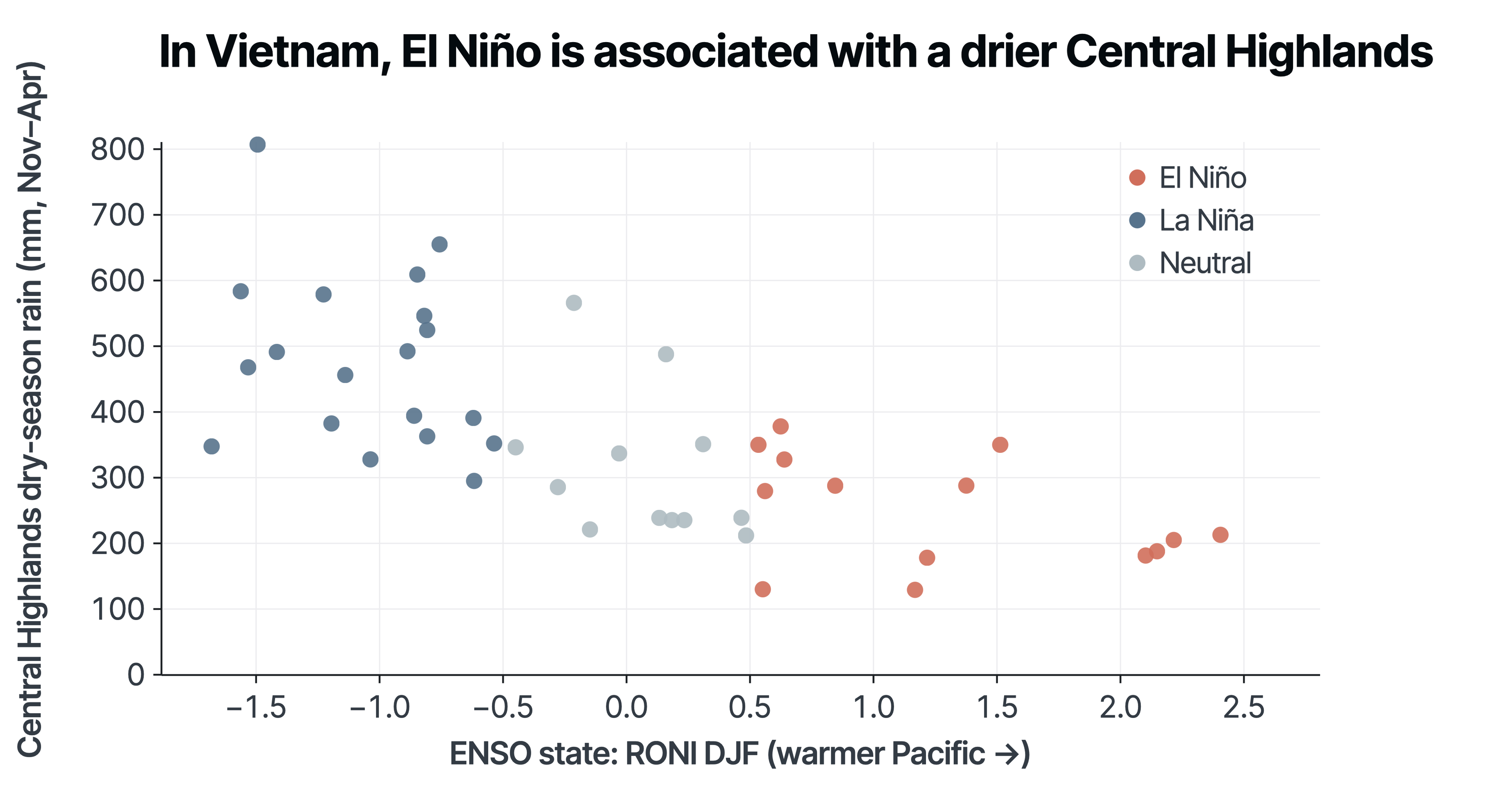
Price does not follow. Across 60 years of robusta price history, the standalone ENSO-to-price correlation is r = 0.06, statistically indistinguishable from zero. The reason is structural: through the dry season, rainfall meets only about a quarter of the trees' water requirement. Farms in the Central Highlands draw the remainder from groundwater and reservoir storage. That irrigation buffer absorbs most of the rainfall deficit before it reaches yield. Under the strongest El Niño on record (2015-16), Vietnamese robusta yield moved by just -0.1%.
The buffer is not unlimited. Dắk Lắk's water table has been falling for a decade, and the province's reservoirs ran dry in 2015-16 before the dry season ended. A prolonged 2026-27 drought would arrive against a thinner cushion than any prior event faced. The drought risk is real and worth monitoring. It has translated to price once in 60 years: in 2024, when the El Niño-driven deficit combined with inventories already at a decade low. That conjunction of depleted stocks and weather shock is the condition worth watching, not the Pacific reading alone.
Arabica
Brazil's arabica works in the opposite direction. The mechanism is counterintuitive from a market risk perspective. The dominant price driver for arabica is not drought but frost. The 1975, 1994 and 2021 frost events each roughly doubled arabica prices. Nothing in the historical record produced comparable price moves from Brazilian drought alone.
Frost in the coffee belt is a cold-air outbreak through the southern Brazilian winter, June through August, largely independent of ENSO. To the extent ENSO modulates it, the relationship favours producers under El Niño. El Niño tilts southern Brazilian winters milder. In Treefera's belt frost stress index, El Niño years register at 0.019, against 0.024 in neutral years and 0.033 in La Niña years. El Niño is the mildest phase.
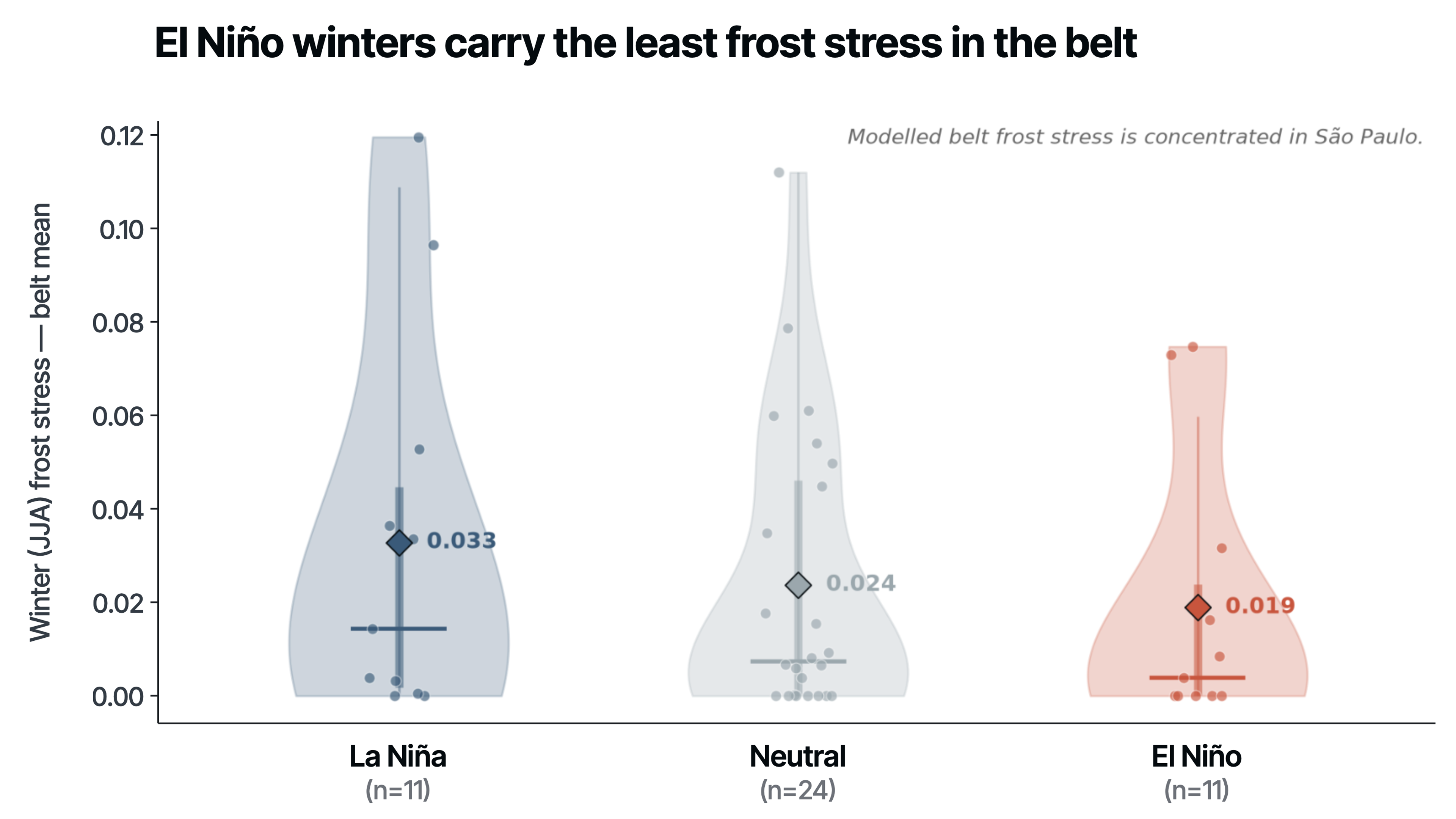
Arabica prices confirm this. El Niño years sit on the bearish side of the distribution, with a median annual return of approximately -5%. The rallies that define arabica price history - 1977, 1994 and 2021-22 - were all frost-driven events in neutral or La Niña winters. The 1997-98 El Niño produced a temporary spike widely cited as an ENSO event; the underlying mechanism was speculative buying into post-1994 frost-tight stocks, with the 1997-98 Brazilian crop largely spared.
Brazil in 2026: the first-mile signal the consensus has not priced
The ENSO picture for arabica tilts mildly bearish via frost risk reduction. The complication sits in what Treefera's Greenprint Weather Pipeline is showing about La Niña's legacy.
Climate stress scores across Brazil's three core arabica-producing states have escalated sharply from 2025 to 2026. Minas Gerais, Brazil's largest arabica origin, has moved from 0.342 to 0.593. São Paulo has moved from 0.093 to 0.581. Bahia from 0.123 to 0.667. All three states are now above the 0.5 threshold that marks materially elevated stress. This escalation reflects soil-moisture deficits accumulated through the preceding La Niña carrying forward into the 2026-27 fruit development window, well before El Niño arrives.
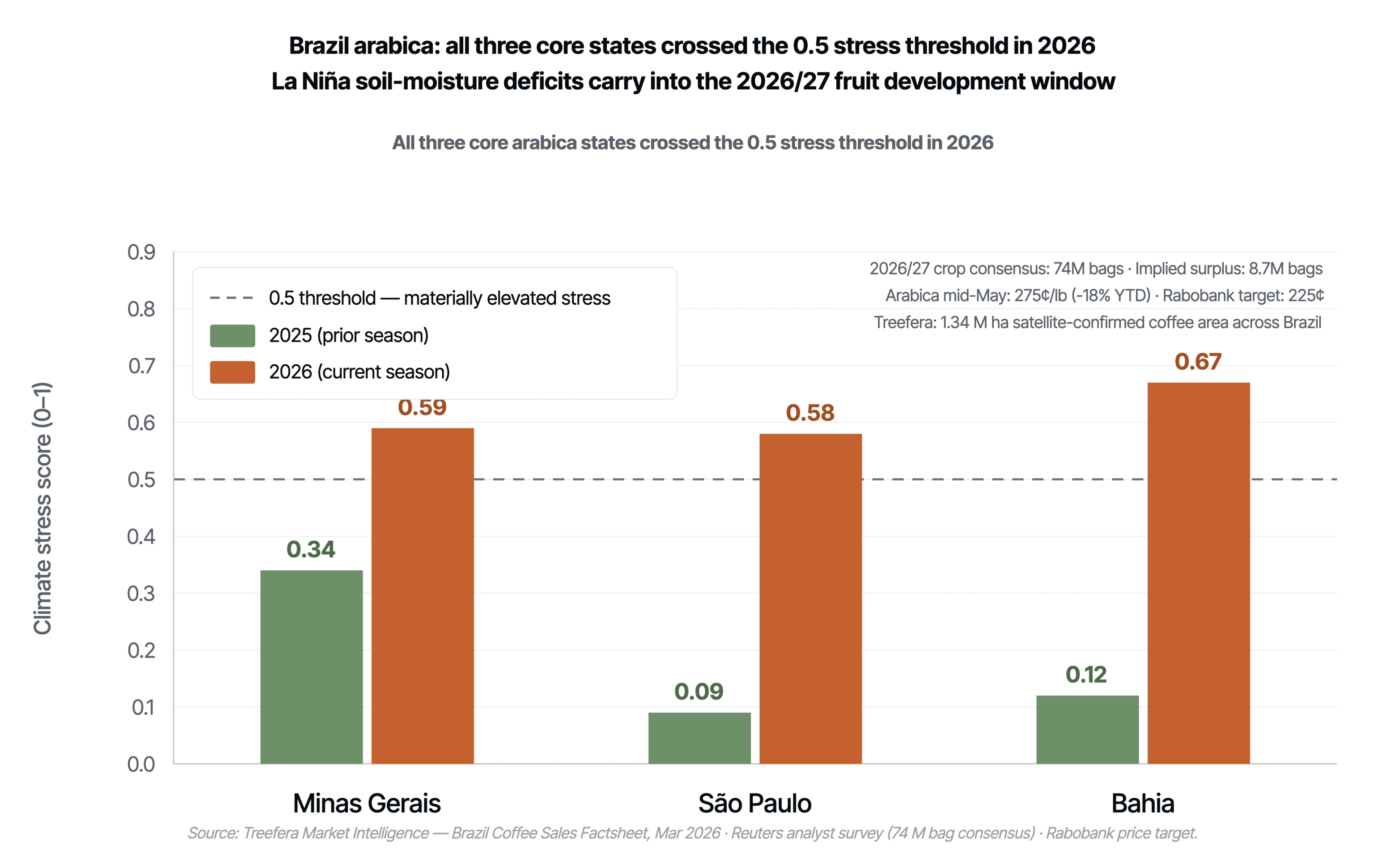
That consensus has not fully absorbed the first-mile stress signal. El Niño's frost reduction is the ENSO story for arabica. The pre-existing soil moisture escalation is the 2026 story. A market allocated on the ENSO basis alone is working from incomplete data; the first-mile signal quantifies the gap.
The view from here
For robusta, El Niño raises the probability of drought in the Central Highlands. The yield impact is buffered by irrigation; the price impact is conditional on stock levels the market can observe independently. For arabica, El Niño reduces frost risk - the one variable with a demonstrated track record of moving arabica prices - while first-mile data flags stress accumulation from the preceding phase. The ENSO forecast alone does not illuminate a clear directional entry point in either market. The distribution of outcomes in both cases is shaped by supply conditions - stock levels for robusta, soil moisture recovery for arabica - that sit in the data from the first mile.