The Cocoa Trigger: El Niño in West Africa
As of June 2026, every major forecasting centre has converged on a strong El Niño for 2026-27. Cocoa prices hit $12,931 per metric tonne in December 2024 - a record - coinciding with the worst West African harvest in a decade. The inference connecting those two facts to the incoming El Niño is almost inevitable. It is also incomplete in a way that determines how you read the outlook.
The signal is real
West Africa grows two-thirds of the world's cocoa beans in a narrow belt spanning Cote d'Ivoire and Ghana. El Niño's signature on that belt is measurable and consistent. Across Treefera's analogue composite - the seven years since 1980 most closely matched to the current RONI forecast - composite growing-season stress sits clearly above neutral. Seventy percent of those years, five of seven, ran hotter and drier than average.
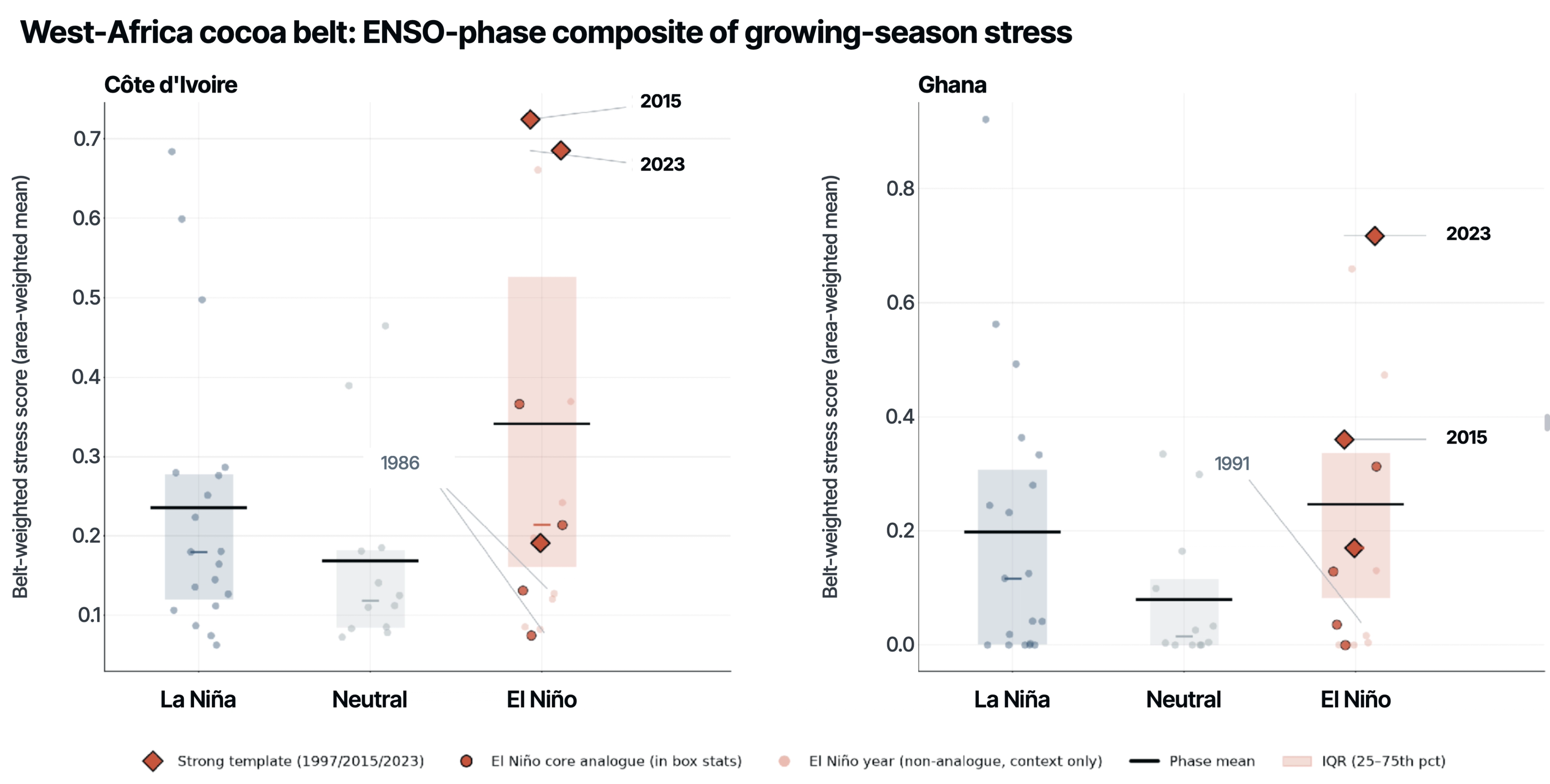
What varies is the magnitude of the hit. Two recent analogues, 2015 and 2023, produced belt stress well above neutral. Quieter El Niño years including 1986 and 1991 sat near it. El Niño reliably shifts the probability distribution toward stress across the West African belt. It does not determine where within that distribution a given year lands. The range of outcomes across analogues is the finding, not a reason to discount the signal.
2023-24 was a two-phase shock
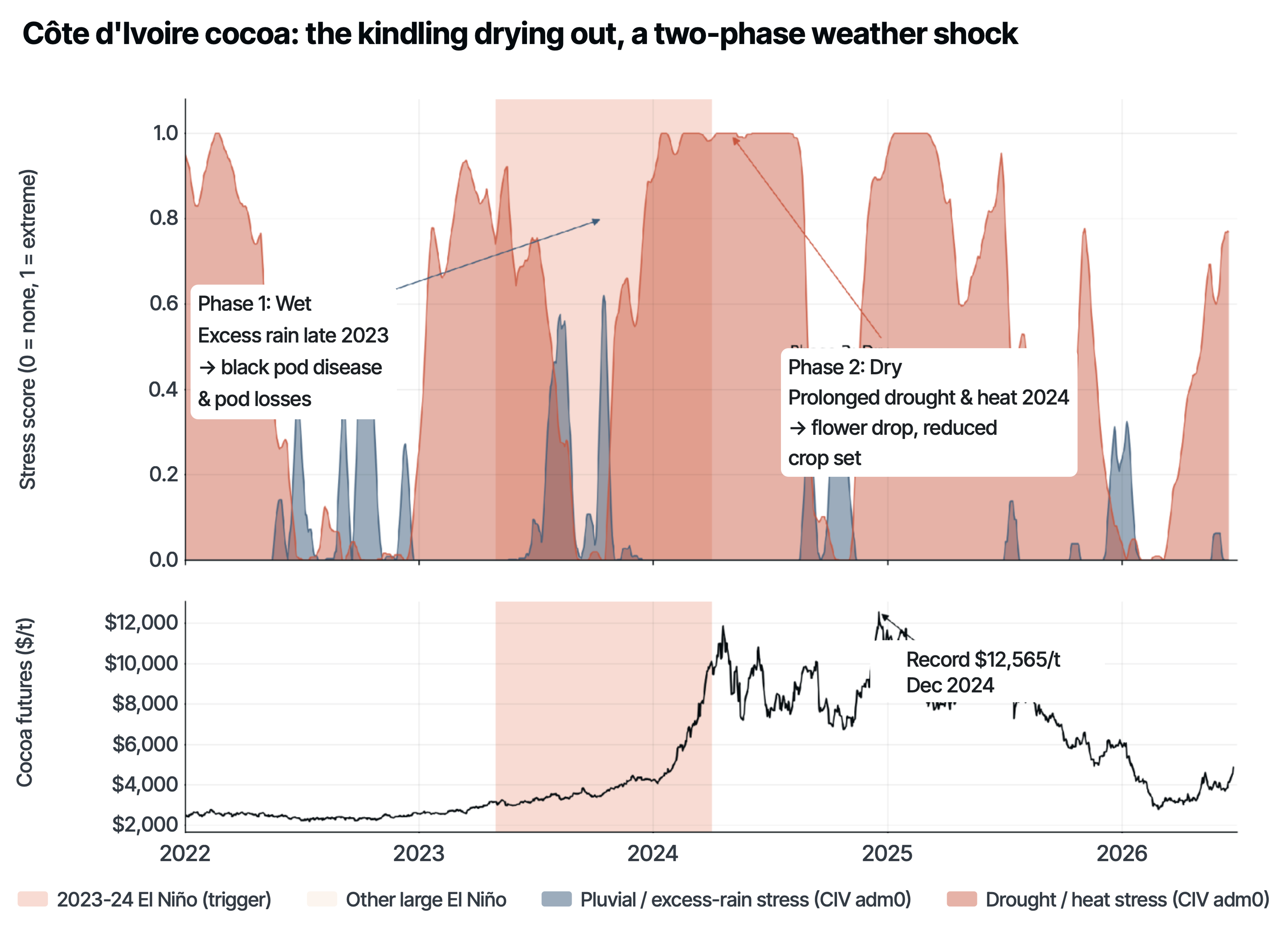
The 2023-24 price spike was not a single El Niño-driven drought event. It was two distinct mechanisms, both ENSO-linked, arriving in sequence.
West Africa's late-2023 rainfall ran at more than twice the 30-year average. That wet phase is visible in Treefera's own belt data. The excess moisture drove a black pod epidemic: Phytophthora palmivora, a fungus that proliferates under sustained saturated canopy conditions, spread through cocoa farms across Cote d'Ivoire and Ghana before the dry season began. Significant volumes were lost before the weather reversed.
Weather then shifted through 2024. Drought and heat cut flowering and pod set across the belt during the critical mid-crop and main crop development windows. The Pacific struck twice: first through anomalous wetness, then through the drought that followed. The same El Niño event generated opposite weather anomalies in sequence, each damaging through a different agronomic pathway.
But the scale of the crisis needed more than weather. Mealybug-borne swollen-shoot virus had been spreading through Ghana's cocoa belt for years - a structural disease pressure entirely independent of rainfall. Trees across both origins are ageing and under-invested, with yield potential per hectare declining structurally. The futures market was carrying more than $8 billion in speculative long positions when the crop shortfall became undeniable. Weather lit the spark. The tinder had been accumulating independently.
What the numbers show
Across all years in the historical record, cocoa-belt weather stress explains approximately 1% of Cote d'Ivoire's production variance and approximately 10% of Ghana's. Even those figures understate 2023-24, because the fungal disease channel sits outside the stress index and materially amplified weather's initial effect.
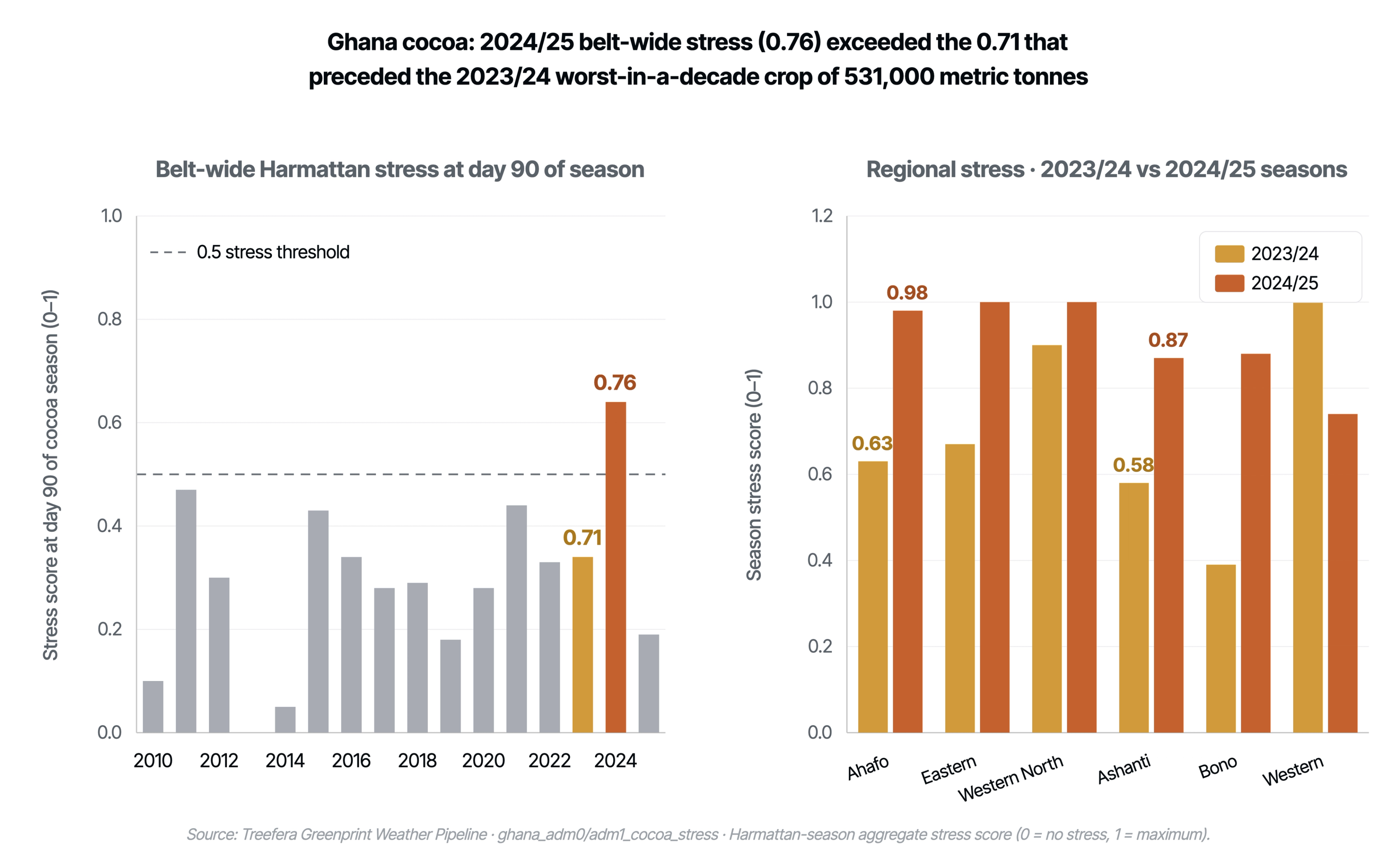
Treefera's Ghana data for the 2024-25 season shows belt-wide day-90 stress reaching 0.76, exceeding the 0.71 that preceded the 2023-24 crop of 531,000 metric tonnes, Ghana's worst harvest in a decade. At the regional level, Ahafo registers a stress score of 0.98 and Ashanti at 0.87 for the 2024-25 season. Those two regions concentrate production from Ghana's highest-yielding belt.
Treefera's Cote d'Ivoire direct coverage through the Greenprint Pipeline went live in June 2026, extending the same granular first-mile signal to the world's largest cocoa origin.
The strongest analogue produced no price spike
The single most important data point for interpreting 2026-27 is the 1982-83 El Niño. That event was Very Strong in RONI terms, landing harder on the West African belt than most of the current forecast's analogues. Cocoa prices went nowhere. The market was in surplus. No weather shock produces a price spike without tight stocks, fragile supply infrastructure and market positioning already aligned. In 1982-83, none of those conditions were present.
The 2026-27 read
El Niño raises the probability of stress across the West African cocoa belt. That risk is running live in Treefera's data. Whether it becomes a price event depends on conditions that are observable independently: stock levels, disease burden and speculative positioning. The structural implication for risk allocation is that the same weather signal has zero price impact in a surplus market and historic impact in a fragile one. The stock and positioning data, not the ENSO forecast, is the decision-critical variable. The 2024 lesson is not that El Niño is always decisive. The 1982-83 evidence refutes that. El Niño is the spark. Whether it meets tinder is a separate question – and the answer changes the outcome entirely.
Insights
Recent News
COMMODITIES INSIGHTS
15 July 2026
El Niño's Split Signal on Coffee: Why the Two Beans Move in Opposite Directions
As of mid-2026, arabica futures sit near 275¢ per pound against a Rabobank central target of 225¢, with market consensus at 74 million bags implying an 8.7 million bag surplus for the new Brazilian cr…