In early September, Cocoa Asia brought close to 500 growers, traders, processors and confectionery buyers to Singapore. Price volatility dominated the conference after two years in which cocoa futures rose to a record, fell by more than half and then began to rise again.
Cocoa futures reached $12,646 a tonne in December 2024, roughly five times their level two years earlier and the sharpest rise in forty years. They fell through 2025 to around $6,000 a tonne by year end, then climbed back above $6,200 a tonne in recent weeks as the market reassessed the 2026/27 West African crop.
Weaker demand contributed materially to the decline from the peak. Chocolate consumption fell by around 5% in both 2024 and 2025, according to J.P. Morgan commodities research, as manufacturers reformulated products, reduced pack sizes and passed costs to consumers. Physical supply remained constrained.
Supply pressure after the 2024 spike
Drought, Harmattan winds and disease compounded across Ivory Coast and Ghana during the 2023/24 season. The two countries produce around 60% of the world's cocoa, and their combined harvest fell by close to a quarter against normal when stocks were already thin. The regional harvest loss therefore materially reduced global supply, while low inventories amplified the effect on price.
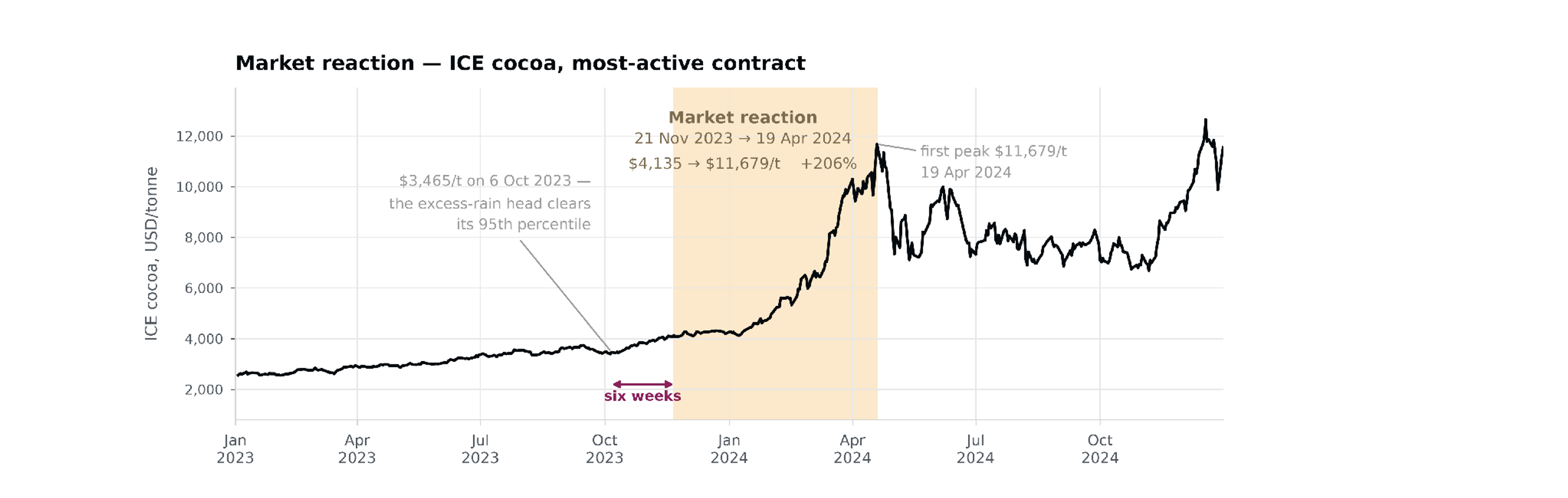
ICE cocoa, most-active contract: the 2023/24 move, from $4,135/t to a first peak of $11,679/t between 21 November 2023 and 19 April 2024.
Treefera's earth-observation record shows how these pressures accumulated in the crop. Drought stress, Harmattan exposure, heat, flood, disease and pod-set risk can be tracked against the locations and biological stages in which cocoa is most vulnerable. These signals provide a physical account of the season alongside price and trade data.
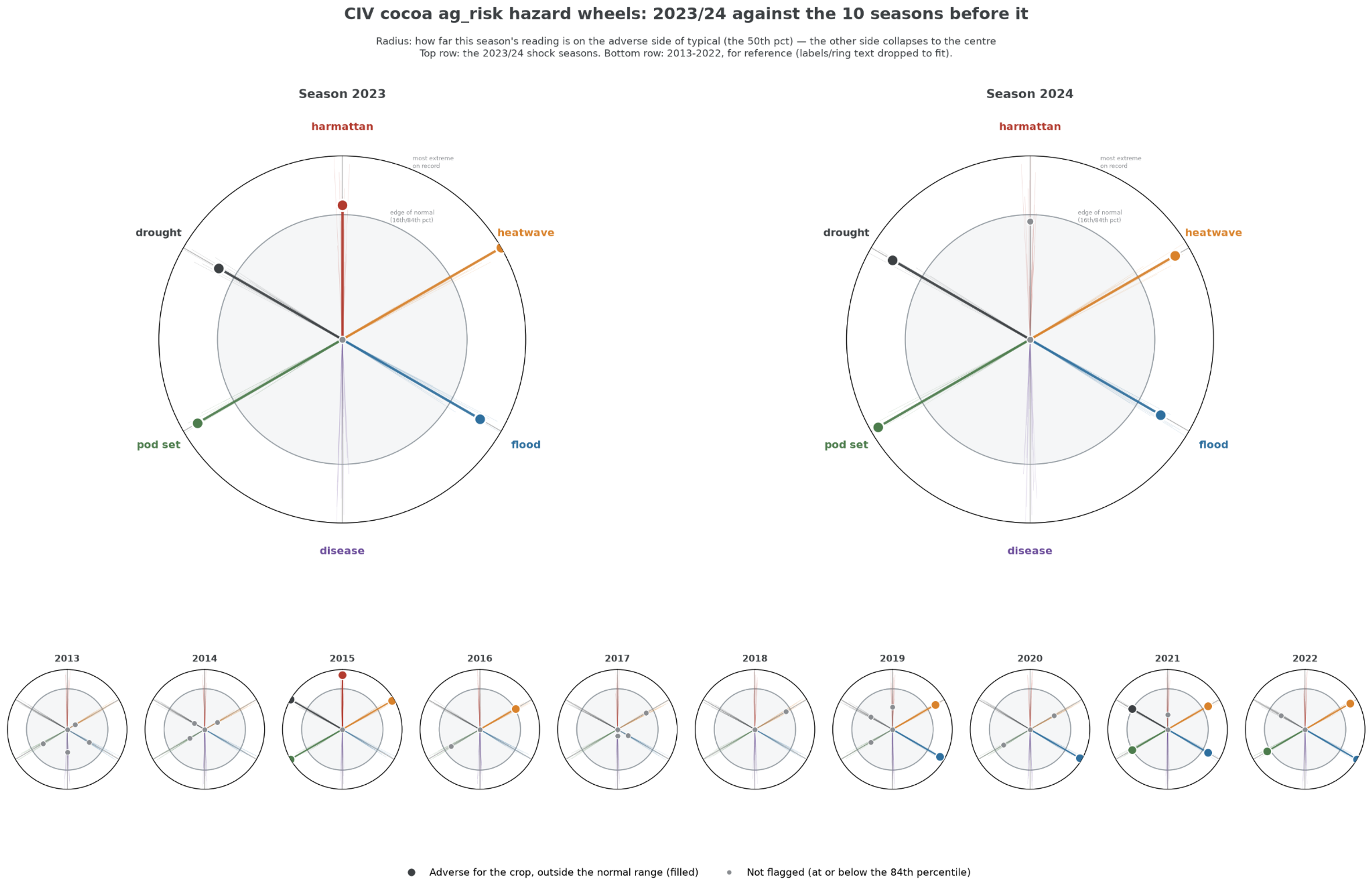
Treefera's drought, Harmattan, heatwave, flood, disease and pod-set hazard readings for the 2023/24 season against the ten seasons before it. A larger dot and longer line indicate a higher risk score.
Current forecasts indicate that the pressure is continuing into 2026/27. Ivory Coast output is expected to fall by roughly a fifth to around 1.75 million tonnes, and Ghana's by around 13% to roughly 650,000 tonnes, as weather and disease pressure weigh on the crop. An El Niño described by forecasters as potentially one of the strongest in 75 years is also building through the Pacific. Futures have since moved back above $6,200 a tonne.
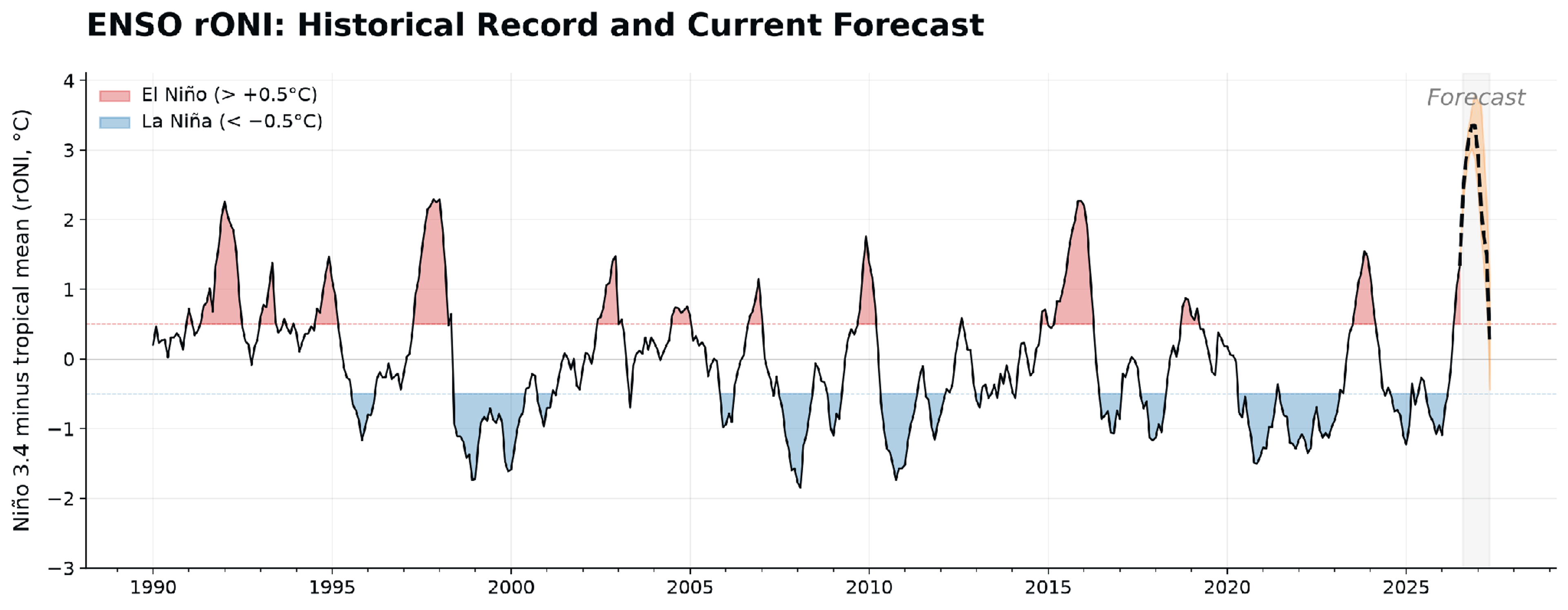
The Niño 3.4 tropical-mean index since 1990, with the current forecast extending through the 2026/27 season. The forecast run sits above every prior El Niño peak in the record.
Buyer decisions depend on current crop evidence
Mondelez described its recent experience with cocoa futures during a keynote panel at Cocoa Asia. The company locked in its 2026 cocoa coverage while the market was near its highs, then watched spot prices fall by roughly half over the following year. Management later cut earnings guidance, citing cocoa costs, while trade coverage questioned whether cocoa could still be hedged with confidence.
Hedging manages price exposure but provides no information about the condition of the crop. Locking in early reduces exposure to another price spike and can leave a buyer above the market if prices fall. Waiting preserves access to lower prices while increasing exposure to further deterioration in physical supply. More current evidence about crop conditions can improve the assumptions used in that decision.
A conference session on building the cocoa balance sheet made the information gap explicit. Much of the industry still works from import and export data and bean surveys. Both are valuable, but they largely describe cocoa that has already been harvested or entered the supply chain. By the time a change is visible in trade data, buyers may be responding to conditions established earlier in the growing season.
Satellite imagery, weather observations and crop models add a more current supply-side view. Applied to cocoa-growing areas and the biological stages in which drought, wind, heat or disease affect production, they provide continuously updated evidence of crop conditions. Historical analogues can then be matched to current geography, crop stage and physical conditions rather than used as generic seasonal averages. This approach informs supply assessment; it does not predict price.
Concentration extends beyond weather
Disease can affect production capacity for decades. Brazil was the world's second-largest cocoa producer through the 1970s and 1980s, growing more than 400,000 tonnes a year. After witches' broom disease reached its cocoa belt in 1989, output fell by roughly 80% over the following decade, to about 100,000 tonnes by 2000. An estimated 250,000 jobs were lost in the region.
Ghana's circumstances and response differ from Brazil's, but disease pressure is significant. A nationwide survey has found cocoa swollen shoot virus at above 30% prevalence in affected zones, accounting for an estimated 15% to 50% of harvest losses where it takes hold. Ghana's cocoa board is compensating affected farmers at a fixed rate per hectare. The effectiveness of intervention depends in part on identifying the spread of disease early enough to respond.
Several buyers at Cocoa Asia also described plans to diversify sourcing towards Nigeria, the Philippines, Indonesia and Peru. Additional origins reduce concentration only when they can provide stable, scalable production under a different set of physical risks. Candidate regions therefore need to be compared across yield stability, climate exposure, disease pressure, infrastructure, deforestation risk and cost.
The same origin data can support EUDR compliance. Traceability establishes where cocoa came from and whether its production meets a defined standard; supply assessment examines the condition of the crop and its growing environment. Plot-level information can support both functions, as well as decisions about sourcing and diversification.
Cocoa remains dependent on concentrated West African production while disease and climate exposure continue to affect output. Demand destruction contributed to the fall from the 2024 price peak, and concerns about the 2026/27 crop have since pushed futures higher.
Buyers still require trade data, bean surveys and hedging instruments. Pairing these with current information about crop conditions can provide earlier evidence of deterioration, identify comparatively resilient production areas and support decisions on sourcing and intervention. Lower prices have not resolved the physical supply constraints that produced the original shock.
This is a read of the physical and market signals behind cocoa's price moves, not trading or investment guidance.
Insights
Recent News