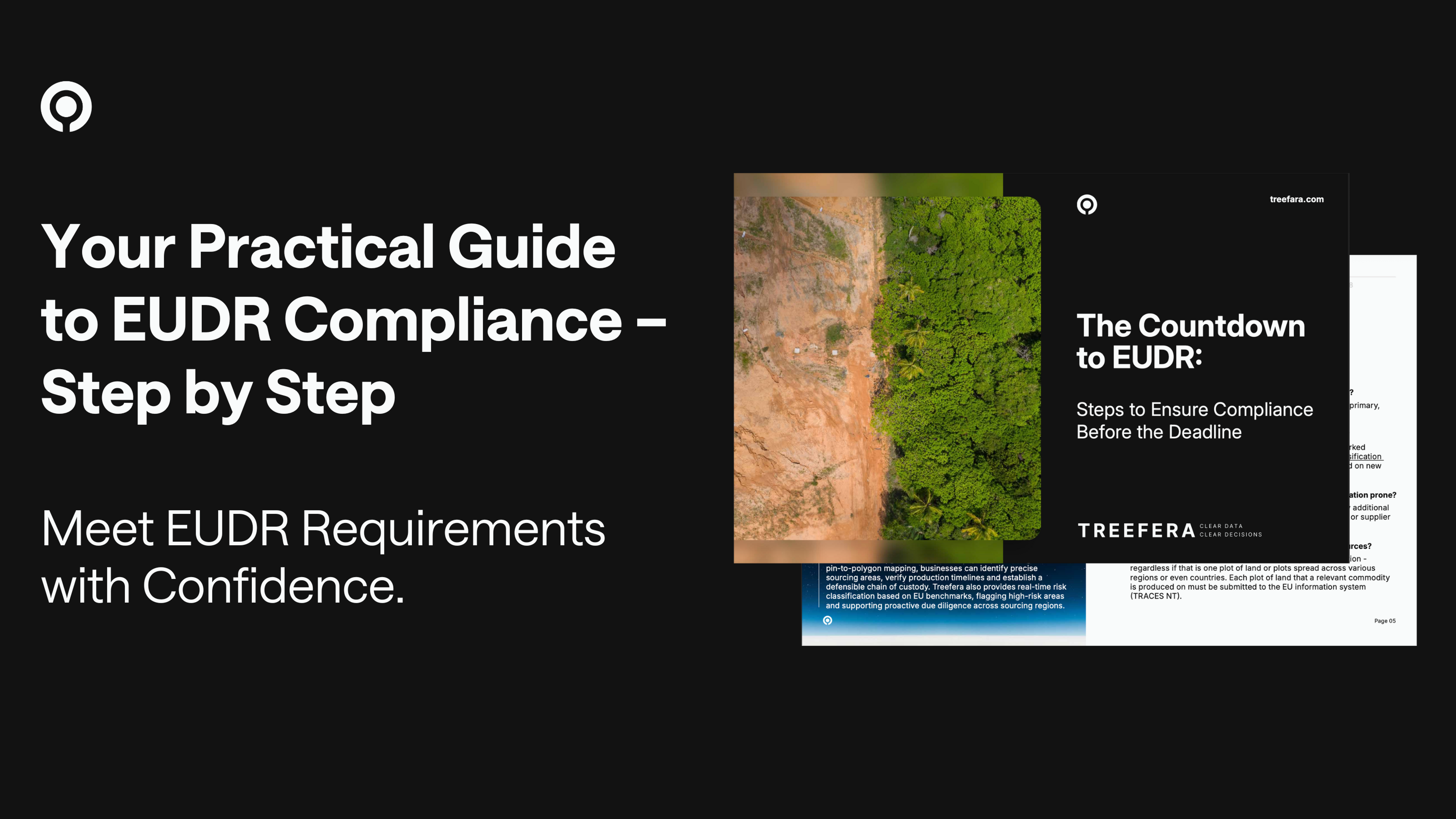
For companies working to comply with the European Union Deforestation Regulation (EUDR), the greatest compliance risks begin in the same place your supply chains does: at the first-mile. This is where commodities are cultivated or extracted and where the EUDR demands evidence of zero deforestation or forest degradation. It is also where visibility is most patchy and risk the hardest to manage.
Whether it is a smallholder farm in a remote area or a new supplier entering the system, the early stages of the supply chain present unique challenges. Under EUDR, the task is no longer just understanding the origin of goods, but providing reliable evidence that production is free from deforestation or forest degradation and meets all relevant legal standards.
The Audit Gap
Compliance teams often find themselves working with incomplete or outdated information. In many cases, producer details are missing or informal. Land use records are hard to verify and changes on the ground such as new clearing activity may go unnoticed for extended periods.
These blind spots create a serious challenge for regulatory compliance. Under the EUDR, companies must provide accurate geolocation data and demonstrate that no deforestation or degradation has occurred since December 2020. Without timely, structured access to this information, even the most well-intentioned sourcing strategies may fall short.
Treefera’s Approach
Treefera addresses this challenge by combining satellite monitoring, AI, land use classifications, direct input from users and structured compliance tools into a single platform. Our system utilizes remote sensing and satellite imagery at a range of spatial and temporal resolutions – allowing us to detect both large-scale and highly localized change with precision. Our AI enabled data fabric also leverages insights on locations, commodities and production from our Environmental Intelligence solution to create a defensible compliance workflow. This is taking both a spatial and temporal approach – informed by historical land-use analysis and real-time observation. With this level and visibility, companies can have confidence in their understanding of how land has changed over time.
Each plot in a customer’s portfolio is evaluated using high-resolution satellite imagery. These images are analyzed for signs of deforestation or degradation, using Treefera’s proprietary AI models aligned with the specific definitions used in the EUDR. When relevant changes are detected, they are timestamped and recorded in the compliance dashboard, alongside supporting visual and contextual information.
Treefera also supports proactive monitoring. The product continuously reviews production locations and issues alerts when patterns indicate a possible risk event. For sourcing teams, this makes it possible to act early, rather than waiting for compliance checks at the point of export. This early detection gives our customers valuable time to make decisions for how to build more resilience and compliance into their processes - helping mitigate potential operational disruptions that are time consuming and costly.
Just as regulations and compliance standards are constantly evolving, so are we. Being a data fabric means we can utilise new data sets as they are released to enhance our outputs and consistently deliver the most accurate and comprehensive analysis possible.
- From Fragmented Inputs to Audit-Ready Outputs
The speed and structure of this process are central to its value. Instead of relying on manual interpretation of multiple data sources, users receive a single, coherent assessment that is ready for inclusion in due diligence documentation. The platform organizes these outputs by production location , which supports both operational response and regulatory review.
Treefera also supports broader context. Alongside current assessments, users can explore how a plot’s land cover has evolved year by year. This historical view can explain why a plot’s current status is low risk, or why it may require further investigation. In either case, the data is centralized, consistent, and usable. - A Defensible and Scalable System
We place a strong emphasis on the credibility of our data and methods. Rather than depending on a single dataset, Treefera brings together multiple validated sources, including satellite imagery, land use classifications and direct input from users. Each decision is recorded and accompanied by metadata that can be reviewed or audited.
Our system is built for scale. Whether monitoring a small number of plots or thousands of locations across several countries, Treefera delivers consistent results. Users can rely on the same logic and structure, even as their compliance requirements grow more complex. And we can do this from limited information. With AI and satellite imagery, we can “fill in the gaps” - providing clear polygon information from a single pin.
Conclusion: Compliance Begins at the Source
Meeting EUDR requirements starts with the ability to monitor land use at the point of origin. Treefera uniquely enables this by transforming raw satellite data into structured, verifiable insights - and helps bring clarity and visibility where there was once incomplete or inaccurate information. By increasing transparency at the first mile, Treefera supports more informed decisions on sourcing commodities and more confident regulatory engagement. With EUDR and beyond, the Treefera data fabric helps companies detect potential issues earlier, prepare documentation more efficiently and reduce the likelihood of costly and time-consuming downstream disruptions.
Insights
Recent News