As of March 2nd, ICE cotton futures are trading near 65 cents per pound, with global balances reflecting a third consecutive season of surplus. On paper, ICAC’s production-over-consumption dynamic suggests adequacy rather than scarcity.
That framing obscures where benchmark risk is concentrated.
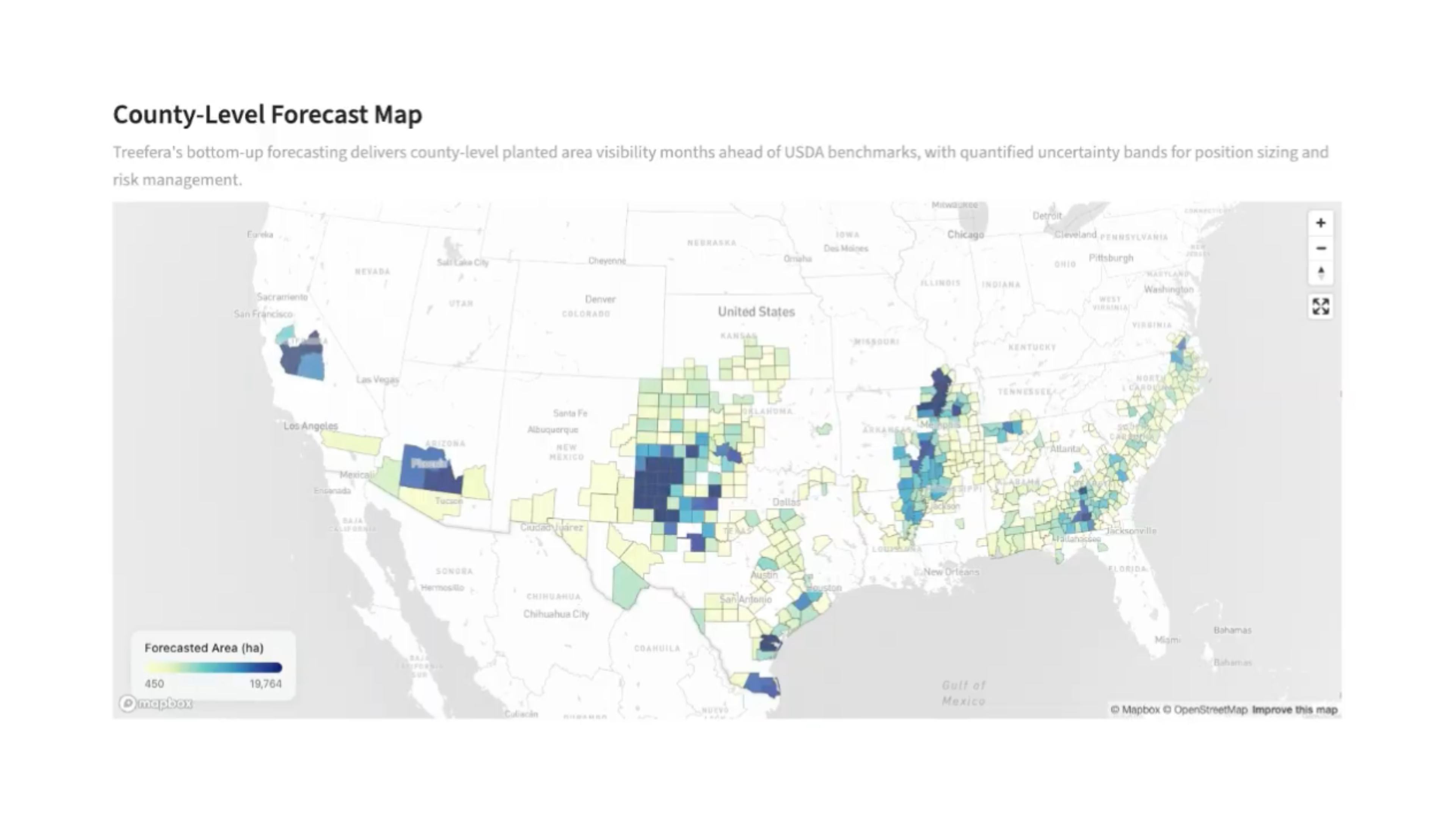
Treefera Market Intelligence data projects U.S. 2026 harvested cotton area at 3.189 million hectares (≈7.88 million acres), approximately +1.0% above 2025. While the country level shows a +1% increase, when we look at a state level there are major difference. In Texas, for example, our model indicates a −20.6% normalisation in harvested area versus 2025, alongside rebounds across parts of the Southeast and Midsouth.
Rather than signalling structural expansion, 2026 reflects redistribution across the Cotton Belt.
Texas remains the fulcrum. In 2025, U.S. harvested area strengthened primarily because Southwest abandonment moderated after three consecutive elevated drought years. That improvement was execution-driven, not acreage-driven. Entering 2026, Southwest soil moisture remains the primary swing factor around baseline.
Cotton differs from many row crops in that planted acres do not guarantee harvested supply. In prior drought cycles, abandonment in Texas exceeded 35-40%, materially altering realised production. The first mile – where soil moisture, stand establishment and early growth conditions determine survival – remains the transmission channel from weather to benchmark price.
Treefera Market Intelligence integrates long-run USDA baselines with satellite-validated land classification and state-level execution modelling. The result is forward visibility into harvested distribution before USDA planting intentions and acreage releases are finalised. That timing is important because official reports measure intention and planting, not survival.
The 2026 baseline projects national stability relative to 2025.
Dispersion risk sits within the mix. A narrower Texas footprint increases sensitivity to Southwest moisture outcomes through April–June. Concurrently, the modelled rebound in eastern states remains exposed to farm economics and spring execution variability.
From a global perspective, the United States accounts for roughly 12% of world cotton production but plays a disproportionate role in exportable supply and ICE contract deliverability. When harvested dispersion occurs in Texas, it transmits through basis, spreads and export availability rather than through global tonnage alone.
Markets currently reflect three years of global oversupply. The conditional variable is whether harvested outcomes align with planted intention in the benchmark origin. If Southwest moisture underperforms, realised U.S. production could compress relative to national acreage expectations despite stable headline planting.
This is not a forecast of scarcity. It is recognition that surplus at the global level does not eliminate dispersion risk at the first mile.
Treefera’s role is not to provide market advice. It is to illuminate structural signals before they are fully reflected in official reporting cycles. In cotton, the gap between what gets planted and what gets harvested remains the decisive variable in price formation.
Sign up for Treefera's bi-weekly commodity insights here