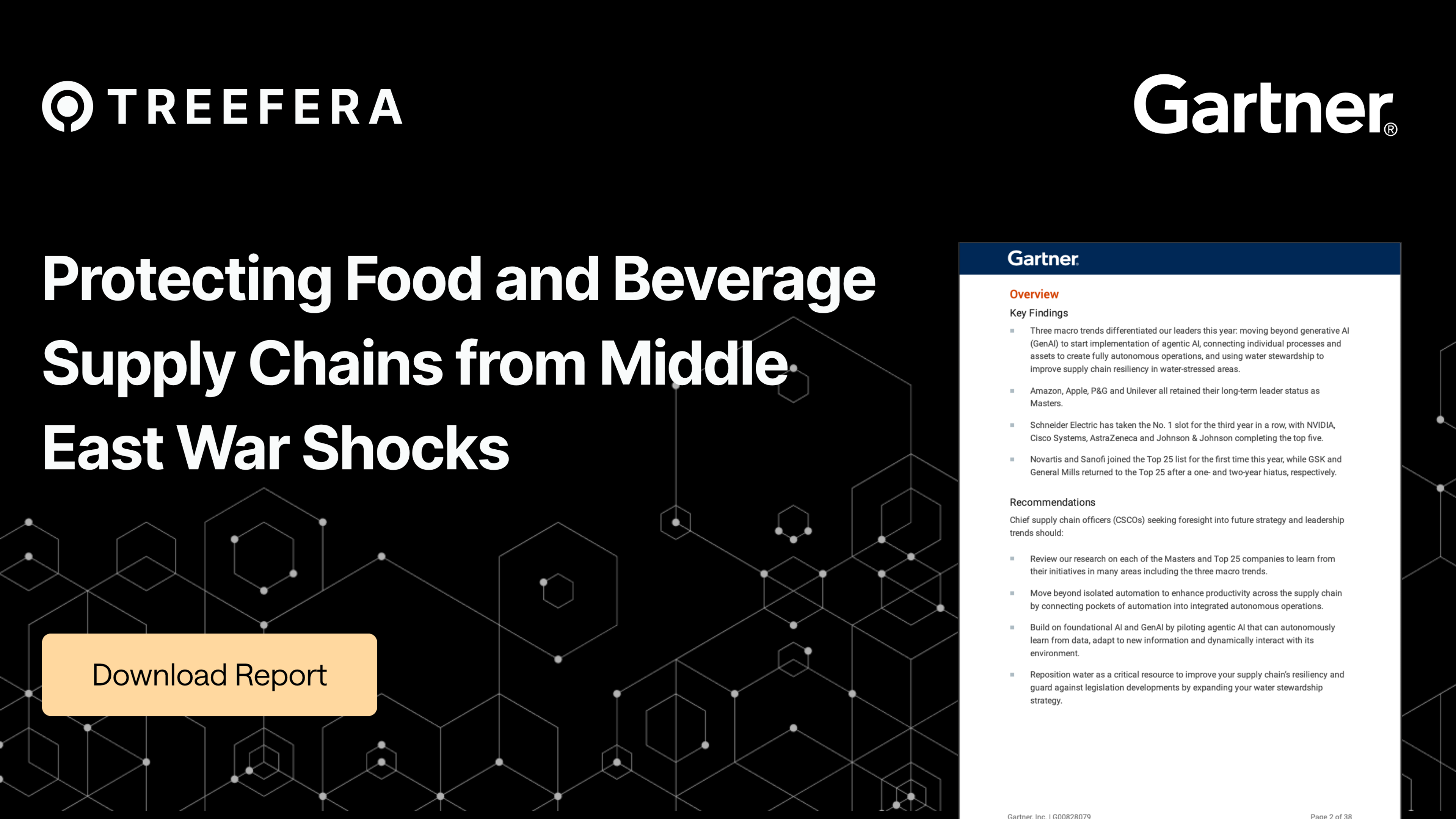
Gartner® published research on the food and beverage supply chain consequences: Protecting Food and Beverage Supply Chains from Middle East War Shocks
We feel the research opens with the framing the rest of the analysis depends on:
"The Strait of Hormuz crisis is not just an energy issue; it's a direct threat to the food and beverage (F&B) supply chain too."
Fertilizer is the leading edge
The strait moves "30% of internationally traded fertilizers (including 30% to 35% of urea and 20% to 30% of ammonia)." Gartner reports that "fertilizer costs from the region have increased an average of 9% compared to pre-closure prices in February 2026, with urea spiking by 28%."
Cost is the first observable signal. Planting decisions, yield trajectories and stewardship spend are not.
What is being priced, what is being measured, what is being inferred
Spot fertilizer cost is being priced. Invoice-level cost change is being measured. What remains inferred or lagged is how those cost spikes translate to planted area, yield outcomes and the durability of regenerative agriculture programs at plot level. Public statistics arrive weeks after planting decisions are made and months after stewardship spend is reallocated.
That gap between live first-mile conditions and reported data is the measurement gap supply chain and financial services firms are exposed to today.
The first-mile transmission
Fertilizer disruption transmits to deliverable supply through several first-mile channels.
Planted area shifts. Farmers reduce or substitute crops in fertilizer-dependent regions when input access tightens. As Gartner notes, "If the war persists, structural changes to farming practices are highly likely."
Yield is shaped by weather & climate volatility and input availability. Fertilizer constraints affect biomass and harvest outcomes. Vegetation and water signals at plot level move ahead of public reporting.
Stewardship is exposed. Gartner notes that "These disruptions could result in farmers reverting to less regenerative farming practices which also put the harvest outputs at risk in the future." The report adds: "Funding to amplify critical regenerative agriculture practices may increase in importance during a time when farmers are financially strapped." Drift away from regenerative practice is invisible at the desk and visible at the plot.
The pattern is general
This pattern, an input cost shock transmitting to planted area, yield and stewardship change at the first mile, is not specific to this conflict. It appears across highly liquid commodities in concentrated sourcing regions. The core issue is information lag and granularity. The implication is volatility and capital allocation distortion.
For fertilizer specifically, the most exposed flows include India (81% of ammonia consumption sourced from the Gulf, per the report), Australia (72% of urea), Brazil and the United States.
Capital-aware lens
The Gartner research finds that only "21% of CSCOs are confident in their ability to deliver against their cost management expectations over a short-term time horizon", a baseline taken before the strait closed. Confidence in cost management is, in part, confidence in the measurement of underlying risk. Coarse data on planted area and yield in fertilizer-dependent regions translates to coarse risk pricing for the firms downstream.
Where Treefera Market Intelligence fits
The Gartner recommended levers (diversified sourcing, preemptive purchasing, hedging, product redesign) require lead time. The available lead time is set by how early operators can see first-mile exposure shift.
We believe Treefera’s Market Intelligence quantifies that exposure at plot resolution. Production Area Forecasting captures planted area shifts ahead of public statistics, operating at approximately 92% accuracy. Yield Forecasting is phenology-aware and crop-stage aware, refreshed weekly with stated uncertainty. Treefera's U.S. corn forecast reached within 1% of the final USDA figure, several weeks before consensus formed with verified uncertainty.
For supply chain operators and financial services firms with exposure to fertilizer-dependent commodity flows, first-mile signal supports earlier execution of the levers Gartner recommends.
Gartner does not endorse any vendor, product or service depicted in its research publications and does not advise technology users to select only those vendors with the highest ratings or other designation. Gartner research publications consist of the opinions of Gartner's research organization and should not be construed as statements of fact. Gartner disclaims all warranties, expressed or implied, with respect to this research, including any warranties of merchantability or fitness for a particular purpose.
Insights
Recent News